
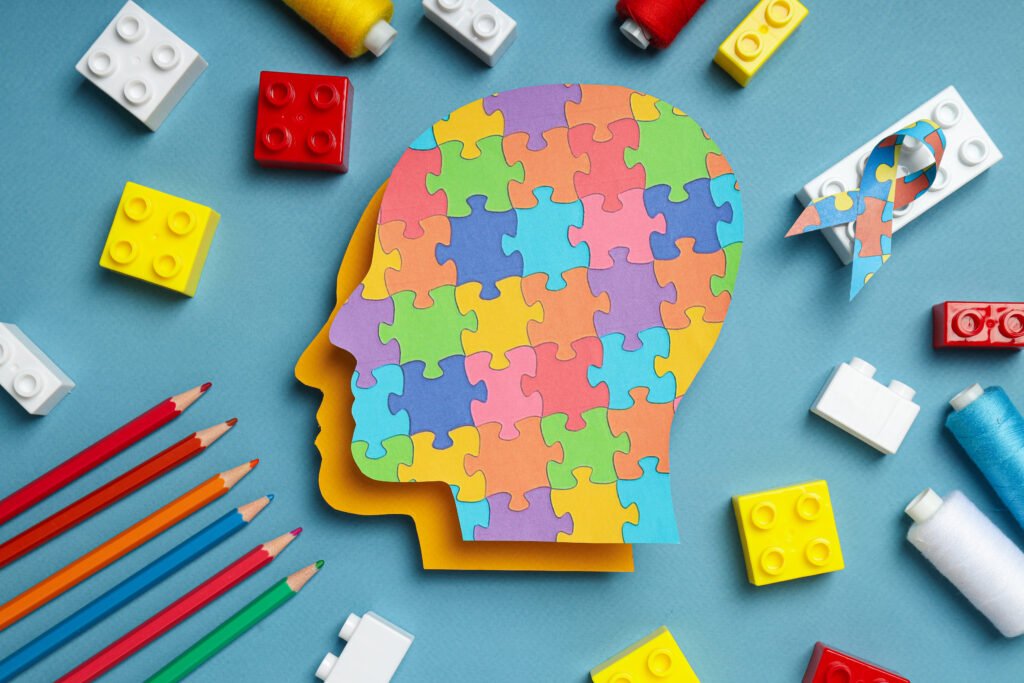
How therapists use colour and creative expression to unlock emotions, build social skills, and help children thrive — the Positive Kids way.
Therapy Built for Kids, by Experts in Kids
At Positive Kids, we believe therapy should feel like a child’s world — creative, safe, and full of possibility. Every one of our therapists is specially trained in social emotional skill development designed specifically for children.
★ SEL Trained Therapists
A child rarely walks into a therapy room and says, “I’m feeling overwhelmed by big emotions I can’t name.” But they might pick up a red crayon and press hard into the paper. They might refuse to use any colour at all. Or they might fill every corner of a page with yellow and declare it their favourite day. Colour speaks where words can’t yet reach — and at Positive Kids, our therapists know exactly how to listen.
Science
Why Colour Speaks Directly to the Emotional Brain
Colour is not merely decoration — it is a neurological event. When light enters the eye, signals travel not only to the visual cortex but to the limbic system, the brain’s emotional centre. This means colour arrives in feeling before it arrives in thought — and in children, whose rational language centres are still developing, this makes colour one of the most powerful tools available to a therapist.
Research in environmental and developmental psychology consistently shows that colour influences mood, anxiety levels, attention, and a sense of safety. For children navigating big emotions for the first time, the colours around them and the colours they choose are rarely random.
“Children communicate most authentically when they are not asked to explain — when they are simply invited to create. Colour is that invitation.”
Colour Guide
What Each Colour Can Mean in a Child’s World
Colour associations in children are shaped by both biology and personal experience. Here’s how therapists at Positive Kids interpret and use the major colours in session:
Blue
Calm · Trust
Lowers heart rate. Children often gravitate to blue when seeking comfort or safety.
Green
Balance · Growth
Linked to nature and renewal. Supports stress recovery and emotional grounding.
Orange
Joy · Energy
Positive Kids’ own colour — warm, sociable, encouraging. Stimulates conversation and connection.
Yellow
Hope · Clarity
Energising and uplifting. Children struggling with low mood often begin to introduce yellow as they progress.
Red
Activation · Passion
Can signal anger, excitement, or urgency. A dominant red in a child’s art often prompts a therapeutic conversation.
Violet
Imagination · Calm
Introspective, gently soothing. Popular in mindfulness activities and anxiety work with older children.
Soft Blue
Safety · Openness
The preferred shade for Positive Kids therapy spaces — welcoming without being clinical.
Neutral
Clarity · Space
Used to balance high-energy environments. Sometimes chosen by children who feel emotionally exhausted.
The Positive Kids Approach
Therapy That Feels Like a Child’s World
Positive Kids was founded on a powerful recognition: that the model of traditional talk therapy — sitting across from an adult and speaking about your inner world — is one that children were never built for. A child’s natural language is play, creativity, and movement. That’s why every Positive Kids therapist is trained in social emotional skill development specifically designed for children — equipping them to meet kids exactly where they are.
★
Our Therapists Are SEL-Trained
Social Emotional Learning (SEL) is the process through which children develop self-awareness, self-regulation, empathy, and social skills. Positive Kids therapists are trained in SEL frameworks designed from the ground up for young people — which means every creative technique we use has a developmental purpose, not just a therapeutic one. When a child paints with abandon or carefully sorts coloured cards, they are practising skills that will serve them for a lifetime.
The result is a therapy environment where children don’t feel like patients. They feel like creators, explorers, and problem-solvers — because that’s exactly what they are.
In the Therapy Room
Creative Ways Positive Kids Therapists Engage Children
Colour and creative expression take many forms in our sessions. Here are some of the core approaches our trained therapists use with young clients:
🎨
Art Therapy & Colour Expression
Children are invited to choose colours freely when painting, drawing, or collaging. The choices they make — and avoid — reveal emotional states that words struggle to reach. A child who reaches for grey consistently may be communicating flatness or grief; one who fills pages in bright orange and yellow may be expressing emerging confidence. Positive Kids therapists are trained to observe these choices without directing them, creating a space where the art does the talking.
🃏
Feelings Colour Cards & Emotion Mapping
One of the most accessible SEL tools for children is the feelings card — a simple set of colours or illustrated faces children can point to or arrange. In Positive Kids sessions, therapists use colour-coded emotion cards to help children externalise and name their inner states. Over time, this builds the emotional vocabulary that is foundational to self-regulation and healthy peer relationships.
🌈
Colour-Based Breathing & Mindfulness
Positive Kids therapists use colour as an anchor in mindfulness and regulation exercises. A child might be invited to take a deep breath every time they spot something blue, or to “breathe in yellow” (calm) and “breathe out grey” (worry). These exercises build the regulation skills at the heart of SEL while keeping sessions feeling playful and child-appropriate.
🏡
Therapeutic Space Design
Before a child speaks a word, the space speaks first. Positive Kids therapy rooms are intentionally designed using colour psychology: soft blues and greens that signal safety, warm orange and yellow accents that encourage openness and energy, and carefully chosen materials that invite touch, creation, and exploration. Children who feel physically comfortable in a space are more likely to feel emotionally safe within it.
📓
Colour Journals & Mood Tracking
For older children, Positive Kids therapists often introduce colour mood journals — daily or weekly logs where children assign colours to their emotional states. These journals become a powerful tool in session, making invisible patterns visible and giving children a sense of ownership over their emotional narrative. A child who can point to a week of grey days and one bright spot has taken a significant step toward self-awareness and agency.
🧩
Play Therapy with Colour-Rich Materials
From sand trays filled with coloured figurines to block play with hued materials, colour-rich play therapy gives children a physical vocabulary for social and emotional situations. Positive Kids therapists observe which colours a child gravitates toward in free play, which they avoid, and how they narrate the stories they build — each choice offering insight that guides the therapeutic relationship.
Social Emotional Learning
The Skills Behind Every Colourful Session
Every creative, colour-based activity in a Positive Kids session is underpinned by the five core domains of Social Emotional Learning. Our therapists are trained to use colour not just as a therapeutic tool, but as a teaching one — building skills children will carry far beyond the therapy room.
Self-Awareness
Naming emotions through colour builds a child’s ability to recognise their own internal states — the foundation of all emotional intelligence.
Self-Regulation
Colour-breathing and mindfulness activities give children practical tools to shift their emotional state — calming the nervous system through sensory engagement.
Social Awareness
Group art activities and shared colour-mapping help children recognise that others have feelings too — and that those feelings may look different from their own.
Relationship Skills
Collaborative creative work builds communication, turn-taking, and cooperation in ways that feel natural and low-pressure for children.
Responsible Decision-Making
When children choose how to respond to an emotional colour prompt, they practise evaluating feelings and making intentional choices — a skill that extends into every area of life.
Emotional Expression
Above all, colour gives children permission to feel and express without judgment — creating the psychological safety that makes all other growth possible.
Cultural Sensitivity
Colour is Never Culture-Neutral
One of the core values at Positive Kids is cultural competency. The associations we attach to colour are not universal — they are shaped by heritage, religion, community, and lived experience. A therapist who assumes that white means purity, or that red means danger, for every child they work with is missing a critical dimension of that child’s world.
White
Purity and new beginnings in many Western traditions. Mourning and death in parts of East and South Asia — a crucial distinction for a grieving child.
Green
Sacred in Islamic traditions. In parts of Latin America, carries associations with envy — a child’s use of green may carry meaning beyond growth.
Yellow
Optimism and happiness in North America. Associated with grief or caution in parts of Africa and Latin America.
Red
Danger and urgency in many Western contexts. Luck, prosperity, and celebration in Chinese and many South Asian traditions.
Positive Kids therapists are trained to approach colour — like all therapeutic tools — through a culturally informed lens, always asking what this means for this child, in this family, from this community.
Our therapists are trained in social emotional skill development specifically designed for kids. Whether your child needs support with anxiety, big feelings, social challenges, or simply a safe space to grow — Positive Kids is here.Book a Session
The Colour of Healing
A Positive Kids blog on colour psychology, creative therapy, and social emotional learning
© 2026 Positive Kids™ · All rights reserved